
Naturopath Melbourne: How to Choose Qualified, Evidence-Informed Care

Clinically reviewed by Emma Hickey — Naturopath & Holistic Nutritionist
Bachelor of Health Science (Naturopathy), Endeavour College of Natural Health
Diploma of Holistic Nutrition, Institute of Holistic Nutrition, Canada
Australian Traditional Medicine Society (ATMS) membership number: 51555
Awarded "Advanced Probiotic Prescriber" from the"Microbiome Restoration Centre"
Bachelor of Primary Education, University of Sydney
550+ clinical consultations
Clinical review date: September 2026
Here is something worth knowing before choosing a naturopath in Melbourne:
Naturopathy is not one of the health professions currently registered by Ahpra under Australia's National Registration and Accreditation Scheme. [1]
That doesn't mean qualified naturopaths don't undertake substantial training.
It means something more important for you as a consumer:
The word naturopath alone doesn't tell you enough.
Two practitioners can both appear when you search “naturopath Melbourne”, yet have very different:
qualifications
clinical experience
professional memberships
evidence standards
approaches to supplements
approaches to testing
willingness to collaborate with your GP
follow-up processes
costs
And that creates the real problem.
Finding a Melbourne naturopath isn't particularly difficult.
Knowing which naturopath you should trust is.
If you choose purely from a polished website, impressive-sounding terminology or promises to uncover one hidden “root cause”, how do you know whether you're about to receive a carefully reasoned plan — or simply another expensive list of supplements and tests?
This guide is designed to help you tell the difference.
And if you're considering working with The Gut Guy, we'll also show you exactly how our Melbourne-based naturopathic service works, where our approach may differ, and situations where we may not be the right service for you.
Why This Page Exists
A lot of people who contact us aren't new to natural healthcare.
They've already tried things.
Sometimes a lot of things.
And the frustration isn't always that they haven't been willing to put in the effort.
Often, it's that they still don't know whether the advice they were given made sense in the first place.
These are some of the concerns we commonly hear:
“I paid for testing, but I never really saw or understood my results.”
“I didn't even do testing. I was just prescribed lots of supplements — and they were expensive.”
“The supplements I was prescribed seemed to cost more than the normal retail price.”
“My treatment plan didn't actually feel personalised.”
“There was so much in my treatment plan that I didn't even know where to start.”
“I've already spent thousands of dollars on naturopaths, doctors, supplements or testing and either didn't improve or actually felt worse.”
“How do I know whether I was even using the right test?”
“I couldn't tell whether my practitioner had additional training relevant to what I was dealing with.”
“I'm completely confused about who I should actually go to.”
“Every time I open social media, there's another supplement claiming to be the next breakthrough.”
“I'm busy. I don't have hours every week to research studies, supplements and tests myself.”
“I've been made to feel like everything I'm experiencing is just in my head.”
“I feel like I'm constantly doing things that manage my symptoms without really understanding what's going on.”
If some of those statements sound familiar, you don't necessarily need more recommendations.
You may need a better way of deciding which recommendations deserve your time and money.
These aren't necessarily reasons to reject naturopathy.
They're reasons to ask better questions before spending more money.
A good practitioner shouldn't expect you to become your own naturopath, researcher, pharmacist and laboratory scientist just to work out whether their recommendations make sense.
Their job should include helping you understand:
what they're recommending
↓
why they're recommending it
↓
what it costs
↓
what outcome you're looking for
↓
how progress will be assessed
↓
and what happens if it doesn't work
That principle runs through everything below.
Already Know You're Looking for Melbourne Naturopath?
You can speak with The Gut Guy before committing to a paid practitioner consultation.
Complimentary. Enjoyable experience.
What Does a Naturopath Actually Do?
Naturopathy is a complementary healthcare discipline that may draw on interventions such as nutrition, lifestyle modification, herbal medicine and nutritional supplementation.
Victoria's Better Health Channel lists services provided by naturopaths as potentially including nutritional and lifestyle advice, herbal medicines, physical approaches and screening or testing. [2]
But that definition alone isn't particularly useful when you're trying to choose someone.
What matters is how those tools are used.
A thoughtful naturopathic consultation might involve reviewing your:
health history → current symptoms → medications → supplements → diet → lifestyle → previous investigations → previous treatments → goals
Then comes the important part:
Deciding what actually needs changing.
Not every patient needs a herbal formula.
Not everyone needs supplements.
Not everyone needs specialised testing.
And sometimes the right recommendation isn't another natural intervention at all.
Sometimes it is:
“This needs to be investigated by your GP or specialist first.”
That distinction matters.
And if you've previously received a long protocol without really understanding why each part was included, that is worth asking about before starting again.
You should be able to ask:
“Why is this part of my plan?”
and receive an answer that makes sense.
What Do Naturopathy and Clinical Nutrition Actually Do?
At The Gut Guy, naturopathy and clinical nutrition are used as a clinical, test-informed approach rather than simply giving everyone the same general diet or supplement advice.
Where appropriate, recommendations are informed by your symptoms, health history and gut-health test results.
For example, a test may identify a biomarker or microbial function that is outside the expected range.
Instead of simply saying:
“Take a generic gut supplement.”
the practitioner asks:
“What nutritional, dietary or lifestyle strategies could reasonably support this particular finding?”
That may involve specific foods, fibres, probiotics, prebiotics or other supplements selected
because they relate to a particular clinical goal.
For example:
Biomarker A is lower than expected
↓
What factors may be contributing to that result?
↓
Are there evidence-informed foods, nutrients or supplements that may help improve it?
↓
Introduce the most appropriate intervention
↓
Monitor symptoms and relevant markers where appropriate
This means the recommendations aren't intended to be random or one-size-fits-all.
The purpose may be to:
reduce particular digestive symptoms
support biomarkers that appear outside the expected range
improve dietary adequacy or variety
support particular microbial functions
identify modifiable factors that may be contributing to the person's overall symptom picture
Importantly, this is also where the limitations of natural healthcare need to be clear.
Naturopaths and clinical nutritionists do not replace medical practitioners.
They cannot diagnose medical conditions outside their scope or perform the full range of medical investigations available through a GP, gastroenterologist or other specialist.
So if your symptoms or results suggest that medical investigation may be required, the appropriate next step may be:
naturopathic or nutritional care + medical investigation
rather than trying to solve everything through supplements and food alone.
That's why we believe good natural healthcare should not exist in isolation.
Use food, nutrition and supplements where they make sense. Use medical investigation where it is needed.
Is Naturopathy Evidence-Based?
This question deserves a more useful answer than either:
“Yes, naturopathy is completely evidence-based.”
or:
“No, naturopathy has no evidence.”
Both oversimplify the issue.
Naturopathy isn't one intervention.
It is a clinical approach that can incorporate multiple interventions.
That creates two separate questions:
1. What evidence exists for whole-system naturopathic care?
2. What evidence exists for the specific intervention being recommended?
A systematic scoping review examining whole-system, multimodality naturopathic medicine identified 33 published studies involving 9,859 participants across a variety of mainly chronic conditions. [3]
However, the review also reported substantial clinical heterogeneity and research of varying methodological quality, including limitations such as potential selection, reporting and publication bias. [3]
So it would be misleading to take that research and conclude:
“Naturopathy is proven to treat everything.”
It isn't.
A much better way to evaluate naturopathic care is to ask:
What evidence supports this particular recommendation for this particular problem — and what are the uncertainties?
That might involve separately examining the evidence for:
dietary modification
lifestyle interventions
a particular nutrient
a particular herbal medicine
a specific probiotic
sleep interventions
behaviour change
another individual intervention
That is what evidence-informed naturopathy should look like.
Not simply using the words evidence-based as a marketing slogan.
Actually being prepared to explain the evidence.
And this distinction becomes even more important if you've already spent significant money on care that didn't help.
A disappointing previous experience doesn't automatically mean every future intervention will fail.
But it also doesn't mean the answer is simply to try more.
Previous treatment gives your next practitioner valuable information.
What was tried?
What changed?
What didn't?
What made you worse?
What was never properly investigated?
A good practitioner should learn from what you've already done rather than automatically starting again from zero.
How Do You Choose the Best Naturopath in Melbourne?
There probably isn't one objectively “best naturopath in Melbourne.”
The right practitioner depends on what you're seeking help with, their training and experience, how they practise, whether their approach aligns with your preferences and whether they recognise the limitations of their own scope.
Instead of asking Google:
“Who is the best naturopath in Melbourne?”
Try asking these questions.
What to compare | What you want to know |
Qualifications | What formal naturopathy qualification do they actually hold? |
Professional membership | Do they belong to a recognised professional association, and is the membership current? |
Clinical experience | Do they have genuine experience relevant to your concerns? |
Evidence | Can they explain why they are recommending an intervention and how strong the evidence is? |
Medication safety | Do they review your medications before recommending herbs or supplements? |
Can they explain exactly how a test result would change your treatment? | |
Supplements | Is every supplement there for a clear reason, or are you automatically receiving a large protocol? |
Medical collaboration | Will they communicate with or refer to your GP or specialist where appropriate? |
Progress | How will you and the practitioner decide whether treatment is actually working? |
Costs | Can they explain likely consultation, testing and supplement costs before you commit? |
This is how we believe searches such as best naturopath Melbourne, good naturopath Melbourne and recommended naturopath Melbourne should be answered.
Not by simply declaring ourselves the winner.
Because you shouldn't have to take a clinic's word for it.
If you're already feeling overwhelmed about who to choose, don't try to compare twenty clinics on every possible detail.
Start with five questions:
1. Are their qualifications clearly stated?
2. Can they explain their clinical reasoning?
3. Are costs reasonably transparent?
4. Will they review whether treatment is actually working?
5. Will they refer elsewhere when something is outside their scope?
You don't need to know everything about naturopathy to make a better decision.
You simply need to know what questions to ask.
The Melbourne Naturopath Decision Filter

If those questions can't be answered clearly, keep comparing.
Qualifications Matter More Than the Word “Naturopath”
Because naturopathy is not one of the professions regulated by Ahpra, checking qualifications is especially important. [1]
The Naturopaths & Herbalists Association of Australia currently recognises eligible contemporary naturopathy programs leading to Bachelor or Master's qualifications, including Bachelor of Health Science (Naturopathy) programs. [4]
There are also experienced practitioners with historically recognised qualifications completed when training pathways were different, so degree status alone shouldn't automatically be used to dismiss an established practitioner.
But there is an important distinction between:
substantial formal naturopathic education
and
a short wellness course.
Professional membership is another useful signal.
For example, practising full membership of the NHAA requires relevant qualification criteria alongside requirements concerning professional indemnity insurance, first aid and continuing professional development. [5]
A membership logo shouldn't automatically persuade you.
But it gives you another useful question to ask:
“What professional standards are you accountable to?”
This is particularly relevant if you've previously thought:
“I don't even know what additional training my practitioner has.”
Formal naturopathic qualifications and additional certifications are not the same thing.
A short certification should not be presented as equivalent to a university-level naturopathic qualification.
But additional education can still be useful information.
Depending on what you're seeking support with, you may reasonably want to ask whether the practitioner has undertaken further training relevant to the clinical work they perform.
Ask:
What qualification do they hold?
What additional training have they completed?
Who provided the training?
How does that training actually influence their clinical decisions?
Credentials should help you understand someone's training.
They shouldn't simply be used as impressive-looking badges.
Meet The Gut Guy's Naturopath
Emma Hickey — Naturopath & Holistic Nutritionist
Emma holds a Bachelor of Health Science (Naturopathy) from Endeavour College of Natural Health and a Diploma of Holistic Nutrition from the Institute of Holistic Nutrition in Canada.
She also holds a Bachelor of Primary Education from the University of Sydney, giving her an education background alongside her clinical training.
Australian Traditional Medicine Society (ATMS) membership number: 51555
Undertaken formal CPDs at the "Microbiome Restoration Centre" and has been awarded the title "Advanced Probiotic Prescriber"
Her current practitioner profile records 550+ clinical consultations.
That teaching background matters more than it may initially seem.
Because healthcare shouldn't simply involve telling somebody what to take.
You should understand what your practitioner is asking you to do.
If you've previously walked away from an appointment with a list of supplements, dietary restrictions and instructions that felt impossible to implement, explanation and prioritisation matter.
A treatment plan may be technically personalised and still be practically useless if it is too overwhelming for the person receiving it.
Emma's role as the clinical reviewer of this page is also intentional.
Rather than having marketing content about naturopathy written without practitioner oversight, the clinical material on this page has been reviewed by a qualified naturopath.
What Makes The Gut Guy's Approach Different?
There are plenty of Melbourne naturopaths who can recommend herbs and supplements.
So that isn't our main differentiator.
Our aim is to make the decision-making around treatment clearer.
1. You Can Speak With Us Before Committing
Before paying for ongoing care, you can first speak with The Gut Guy.
The purpose isn't to diagnose you over the phone.
It is to understand:
Where are you now?
What have you already tried?
What are you hoping will be different?
And does our service actually fit what you're looking for?
If it doesn't, knowing that before another paid consultation is useful information too.
2. Naturopathy Doesn't Operate Alone
The Gut Guy works through a collaborative practitioner model involving naturopathy and clinical nutrition.
Sarah Wade holds a Bachelor of Health Science in Clinical Nutrition, is a Certified Practising Nutritionist, and is registered with the Australasian Association and Register of Practising Nutritionists.
That means nutritional strategy doesn't necessarily need to be squeezed into the same consultation as every other aspect of naturopathic care.
Different practitioners can contribute different strengths.
3. We Believe Medical Care and Naturopathic Care Can Coexist
You shouldn't have to choose a side.
A naturopath doesn't replace your:
GP
gastroenterologist
endocrinologist
psychologist
pharmacist
or another appropriate medical professional
Victoria's Better Health Channel advises people using complementary therapies to tell their regular doctor about complementary products and treatments because interactions with medicines or other aspects of treatment can occur. [6]
That is why medical collaboration isn't an inconvenience.
It is a safety feature.
4. Testing Should Answer a Question
One of the easiest ways for healthcare to become expensive is:
without anybody asking whether the first test meaningfully changed anything.
We prefer a simpler question:
Will the result meaningfully change what we do?
If the answer is no, why are we testing?
That question becomes particularly important if you've previously thought:
“I paid for a test but never really saw my results.”
or:
“How do I know whether I was even using the best test?”
There isn't necessarily one best test for every person.
A more useful question is:
“What is the best test for the clinical question we're trying to answer?”
Those are very different questions.
A more expensive test isn't automatically better.
A test containing more biomarkers isn't automatically more useful.
And testing isn't automatically superior to a thorough clinical assessment or appropriate conventional pathology.
Before paying for a test, ask:
What are we looking for?
Why this test rather than another one?
What does it measure?
What are its limitations?
Will I actually see my results?
Will somebody explain the results to me?
What happens if the result is normal?
What happens if the result is abnormal?
How would either outcome change the plan?
If those questions can't be answered clearly before the test, that's useful information in itself.
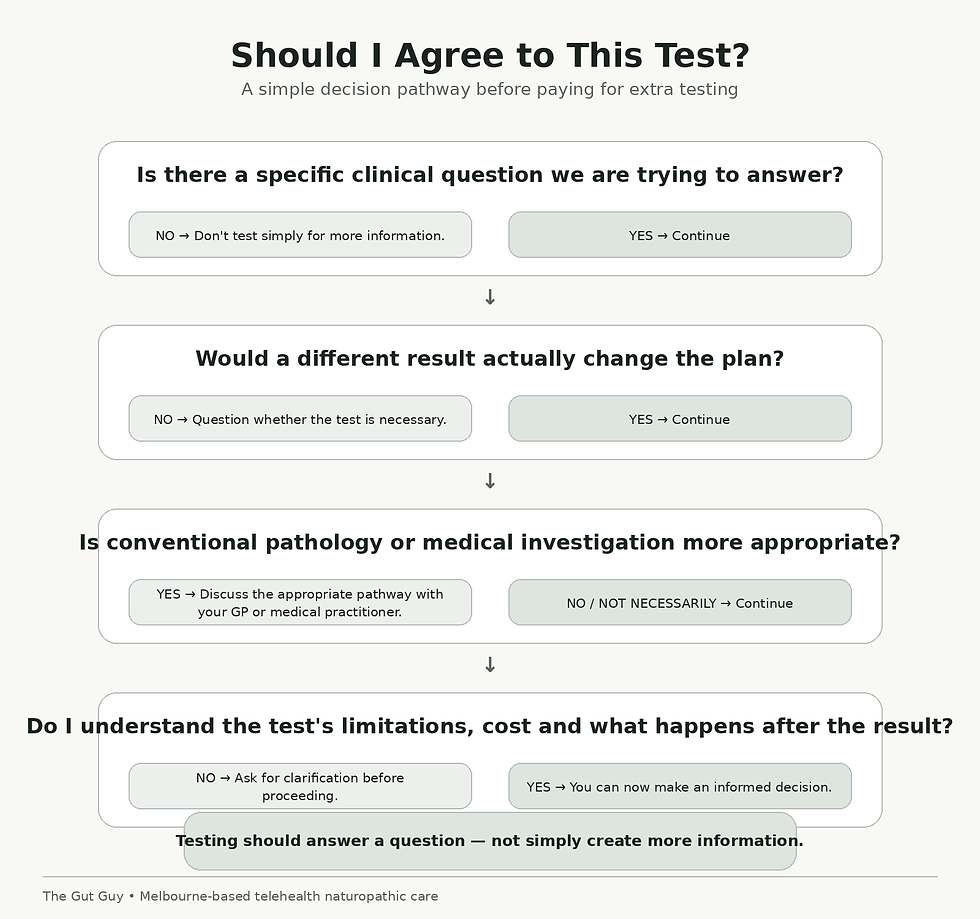
Now you can make an informed decision.
What Should Happen After You Pay for a Test?
Testing shouldn't end when the laboratory sends back a complicated report.
The result needs context.
Ideally, you should understand:
What was actually measured?
What findings appear relevant?
What findings may be less meaningful?
What are the limitations of the test?
What, if anything, does the result change?
The goal isn't to overwhelm you with every number on a laboratory report.
It's to turn information into a sensible next decision.
Because receiving a complicated test result without understanding it doesn't create much clarity.
5. You Shouldn't Need to Become a Full-Time Researcher
Healthcare is complicated.
Most people already have:
work,
family,
relationships,
appointments,
finances,
and everyday life to manage.
They don't have hours every night to compare:
supplement formulations,
laboratory methodologies,
practitioner qualifications,
clinical papers,
different tests,
and conflicting social-media advice.
And they shouldn't have to.
One of the reasons people seek professional help in the first place is to reduce uncertainty.
The practitioner's job should be to simplify the decision — not give you more homework than you can realistically manage.
That doesn't mean blindly following recommendations.
It means the reasoning should be explained clearly enough that you can make an informed decision without spending your evenings trying to become your own clinician.
More Supplements Does Not Mean Better Naturopathic Care
Imagine this.
You leave your first appointment with:
six supplements,
three herbal products,
a new diet,
two tests,
and several hundred dollars in additional costs.
It may look comprehensive.
But comprehensive and necessary are not synonyms.
The better question is:
Can somebody explain exactly why every intervention is there?
For each supplement, you should be able to understand:
Why this?
Why this dose?
How long?
What outcome are we monitoring?
What are the possible interactions or adverse effects?
When do we stop it?
And there are two more questions people often forget to ask:
“What does this product normally retail for?”
and:
“Am I paying any additional dispensing or clinic margin?”
Clinics have different dispensing arrangements, and there can be legitimate reasons why prices differ.
But supplement pricing should not feel mysterious.
If you're being asked to purchase several products, you should understand:
what each one is
why you're taking it
how long it's expected to last
what outcome is being monitored
and what it costs
If you're concerned you've previously paid significantly above ordinary retail pricing, ask for an itemised breakdown before buying.
Transparency around supplements is part of informed decision-making too.
What If I Was Prescribed Lots of Supplements Without Any Testing?
Not having a specialised test doesn't automatically mean a supplement recommendation is inappropriate.
Testing isn't always necessary.
But the absence of testing also shouldn't mean:
guess → prescribe → add more → hope something works
The important question remains:
What is the clinical rationale?
A practitioner may sometimes have enough information from:
clinical history
symptoms
existing pathology
diet
medication history
previous treatment
to make an appropriate recommendation without ordering another test.
Other times, additional information may be useful.
The standard shouldn't be:
“Everyone needs testing.”
or:
“Nobody needs testing.”
It should be:
“Would obtaining this information meaningfully improve the decision we're trying to make?”
The 5-Question Supplement Check

Every intervention should earn its place.
Your Social Feed Is Not a Treatment Plan
If you spend enough time looking at health content online, almost every week brings a new breakthrough.
A new probiotic.
A new powder.
A new herb.
A new test.
A new “must-have” supplement.
The problem isn't necessarily that every product is useless.
The problem is that:
an algorithm doesn't know you.
It doesn't know:
your medications,
your pathology,
your medical history,
what you've already tried,
what made you worse,
your budget,
your diagnosis,
or whether the product you're seeing is even relevant to you.
Social-media algorithms are designed to keep showing you content you're likely to engage with.
They're not conducting a clinical assessment.
So before buying the next product that appears in your feed, ask:
“What specific problem am I trying to solve — and what evidence do I have that this particular product is relevant to that problem?”
Sometimes the smartest supplement decision is not buying another one.
If you do find a supplement that you feel might be beneficial, then you can always mention it to your naturopath for approval.
Herbal Medicine Melbourne: “Natural” Does Not Mean Risk-Free
Herbal medicine is commonly used within naturopathic practice and is also a standalone area of complementary healthcare.
But one of the worst assumptions a practitioner could encourage is:
Natural = automatically safe.
It doesn't.
Victoria's Better Health Channel warns that herbs can interact with pharmaceutical medications and advises people to tell their doctor about herbal medicines they are using or considering. [7]
A systematic review and meta-analysis has also documented interactions between herbal products and prescribed medications. [8]
That is why responsible herbal medicine in Melbourne should consider:
medications
dose
the particular herbal preparation
potential interactions
contraindications
pregnancy and breastfeeding where relevant
the condition being addressed
the evidence for the particular intervention
The right question is not:
“Is herbal medicine natural?”
It is:
“Is this particular herbal medicine appropriate for me?”
What Does “Personalised Naturopathy” Actually Mean?
Almost every Melbourne naturopath website tells you its treatment is personalised.
But putting your name at the top of a supplement plan doesn't make it personalised.
Real personalisation should change clinical decisions.
Two people with the same symptom could reasonably receive different recommendations because they have different:
medical histories,
medications,
diets,
previous treatments,
tolerances,
pathology,
lifestyle constraints,
risk factors,
health goals,
and responses to previous interventions.
Personalisation should therefore answer:
Why does this recommendation make sense for this person?
There is another part of personalisation that often gets overlooked:
Can you actually follow the plan?
A treatment plan can be completely unique to you and still be poorly designed if it asks you to change twenty things at once.
For somebody working full time, raising children, studying, travelling or managing other responsibilities, a realistic plan may need to look more like:
PRIORITY 1
What matters most right now?
PRIORITY 2
What can wait until the first change is established?
OPTIONAL
What might be useful later but doesn't need to happen today?
If your previous treatment plan felt so complicated that you barely knew where to begin, the plan may simply have needed better prioritisation.
Personalised care should account for your biology and your actual life.
If everybody receives essentially the same protocol, the label personalised doesn't mean very much.
What Happens During a Naturopathic Consultation?
The details vary between practitioners, but a good consultation should reduce uncertainty — not add to it.
At The Gut Guy, your pathway may vary depending on what you're seeking support with, but the logic should look something like this:
Your Consultation Journey
STEP 1 — CLARITY
You first speak with The Gut Guy about what's happening, what you've already tried and what you're hoping to achieve.
↓
STEP 2 — CLINICAL ASSESSMENT
Where appropriate, the practitioner reviews relevant health history, symptoms, medications, supplements, diet, lifestyle and previous investigations.
↓
STEP 3 — PRIORITISE
Instead of trying to change everything, decide:
What are the most useful next steps?
This is particularly important if you're busy.
The goal isn't to hand you twenty tasks.
It's to identify what deserves your attention first.
↓
STEP 4 — TREAT / INVESTIGATE
Recommendations may involve nutrition, lifestyle interventions, herbal or nutritional products, further investigation or other appropriate strategies.
Testing isn't valuable merely because it generates more information.
↓
STEP 5 — REVIEW
Did the strategy help?
What changed?
What didn't?
What should be continued, removed or adjusted?
If you've previously spent thousands of dollars without knowing whether anything was working, this is where the process should look different.
There should be a point at which somebody asks:
“Is this actually helping?”
Not:
“What can we add next?”
↓
STEP 6 — REFER WHEN NEEDED
If something appears more appropriate for medical investigation or another practitioner, that should become part of the plan.
Naturopathic Consultations From as Little as $15 Per Week
Cost shouldn't have to mean choosing between getting professional guidance and managing your normal weekly expenses.
At The Gut Guy, naturopathic consultations can be placed on a payment plan from as little as $15 per week.
0% interest.
No lengthy finance application.
No long sign-up process.
The purpose is simply to make the cost of naturopathic care easier to manage rather than requiring the full amount at once.
Before proceeding, we can explain the total consultation cost, payment schedule and what is included, so you know what you're committing to.
There is no advantage in advertising a small weekly figure if someone doesn't understand the overall cost.
Transparency matters.
And because many people contacting us have already spent substantial amounts elsewhere, a payment plan should make care easier to manage — it should never be used to disguise the total cost of care.
What Should Happen If Naturopathic Treatment Isn't Working?
This is one of the questions I would ask before choosing a practitioner.
Because almost any strategy can sound convincing before you try it.
What happens afterwards tells you a lot about the clinical reasoning.
If an intervention isn't producing the expected result, there are several possibilities:
The original hypothesis may have been wrong.
The intervention may not be effective for you.
The dose or implementation may not be appropriate.
More information may be required.
Another practitioner may be better suited to the problem.
Or the issue may require medical investigation.
What shouldn't automatically happen is:
“Let's add another five supplements.”
This matters even more if your previous experience has been:
“I've already spent thousands and either nothing changed or I actually felt worse.”
Past spending can create a psychological trap.
You've already invested so much money that it can feel as though you have to continue.
But the amount already spent isn't evidence that the same strategy deserves more time.
Sometimes the most useful decision is to:
stop
simplify
reassess
seek another opinion
or
refer into appropriate medical care
rather than continuing simply because you've already invested heavily.
A practitioner should be willing to reconsider the original hypothesis.
A good treatment plan should contain a feedback loop.
Evidence-Informed Care Is a Loop
ASSESS

Treatment should generate information, not just invoices.
This feedback loop also helps prevent treatment from becoming endless symptom management.
Symptom relief can absolutely matter.
If you're uncomfortable or struggling, improving symptoms is a worthwhile outcome.
But where appropriate, a practitioner should also ask:
What might be contributing to these symptoms?
Is there anything modifiable?
Is further investigation appropriate?
Are we only managing the problem, or are we learning something from the response?
That does not mean promising to discover one hidden “root cause” behind every health problem.
Human health is rarely that simple.
It means not confusing:
temporary symptom relief
with
a complete understanding of why the symptom is occurring.
Why We Aren't Publishing a “Top 10 Naturopaths in Melbourne” List
You may have arrived here after searching:
best naturopath Melbourne
recommended naturopath Melbourne
or even:
top 10 naturopaths in Melbourne
We could produce a list.
It would probably attract clicks.
But ranking ten practitioners fairly would require continually assessing their current:
qualifications
memberships
availability
clinical interests
prices
evidence approach
reviews
locations
service models
And if we put ourselves at number one?
You'd quite reasonably ask:
“According to whom?”
Instead, we'd rather give you a framework for making the decision yourself.
If another Melbourne naturopath fits your needs better after applying it, choosing that practitioner is probably the right outcome.
That's more useful than pretending an internally written league table is objective.
Green Flags and Red Flags When Choosing a Melbourne Naturopath
Green flags | Questions worth asking if you see the opposite |
Clearly lists formal qualifications | Qualifications are vague or difficult to verify |
Explains uncertainty | Every health problem appears to have one simple cause |
Asks about your medications | Supplements or herbs are recommended without checking medicines |
Explains why testing is needed | Expensive testing appears automatic |
Provides a rationale for supplements | Large protocols are prescribed without explanation |
Measures progress | There is no clear way to know whether treatment is working |
Works alongside medical care | You are discouraged from seeing your GP or specialist |
Discusses likely costs | Costs keep appearing after you've committed |
Changes the plan when evidence changes | Every lack of progress leads to more treatment |
Is willing to say “I don't know” | The practitioner appears certain about everything |
How to Choose a Naturopath in Melbourne Checklist
It's useful even if you ultimately choose another clinic.
And that's the point.
☐ What formal qualifications do you hold?
☐ What additional training or certifications are relevant to the care you provide?
☐ How do you decide whether I actually need testing?
☐ Will I receive my test results and have them explained to me clearly?
☐ How do you decide which supplements are actually necessary?
☐ Can you explain the expected supplement costs before I buy them?
☐ How will we measure whether my treatment plan is actually working?
☐ What happens if I don't improve or I feel worse?
☐ When would you refer me to a GP, gastroenterologist or another specialist?
☐ What is the likely total cost of care, including consultations, testing and supplements — not just the first appointment?
If You're Still Unsure Who to Choose
You don't need to find the “perfect” practitioner before making a decision.
You need enough information to make a reasonable decision.
If two practitioners both look suitable, speak to them.
Ask how they think.
Ask what their process looks like.
Ask what the expected costs are.
Ask how they approach testing.
Ask what happens when something doesn't work.
Ask how they decide whether a supplement is necessary.
The quality of the answers may tell you more than another hour reading websites.
Online Naturopath Melbourne: Do You Need to Attend a Clinic?
Not necessarily.
The Gut Guy is Melbourne-based, with its business address in Carlton, while practitioner consultations are offered online via telehealth.
For some people, that removes:
travel
parking
waiting rooms
additional time away from work
But we also want to be transparent:
If face-to-face naturopathy is essential to you, our model may not be the best fit.
Our goal isn't to convince everybody to choose us.
It's to help the right person decide whether our approach suits them.
How Much Does a Naturopath Cost in Melbourne?
There isn't one universal Melbourne naturopath fee.
Fees can depend on:
appointment length
practitioner experience
the clinic model
whether additional professionals are involved
testing
supplements
follow-up requirements
The initial consultation price also doesn't necessarily tell you the total cost of care.
So rather than asking only:
“How much is the first appointment?”
consider asking:
“What am I likely to spend on consultations, tests and recommended products before we can reasonably evaluate whether this approach is working?”
That can reveal far more than comparing headline consultation prices.
If you've already spent a lot of money on previous care, comparing price alone may not solve the problem.
The cheapest practitioner can become expensive if you undergo months of ineffective treatment.
The most expensive practitioner isn't automatically the most skilled.
Instead, consider value and transparency:
What does the consultation include?
What costs might come afterwards?
How many appointments are expected?
Are supplements optional or required?
Is testing likely?
How will progress be assessed?
What happens if you aren't improving?
Cost matters — but knowing what you're paying for matters too.
At The Gut Guy, there is also another option if paying the consultation cost in one amount isn't convenient:
Naturopathic consultations can be paid from as little as $15 per week.
The payment plan is interest-free and involves no lengthy sign-up process.
We can explain the total cost and payment schedule before you proceed, so the weekly figure doesn't obscure the overall cost.
Naturopathy and Your GP Don't Have to Compete
There is a false choice sometimes presented in healthcare:
Natural medicine OR conventional medicine.
We don't think that is particularly useful.
Your GP may be the appropriate professional for:
diagnosis
prescription medication
medical pathology
investigation of red flags
imaging
specialist referral
management of recognised medical conditions
A naturopath may contribute different skills in areas such as dietary, lifestyle, herbal or nutritional strategies within their training and scope.
The two don't need to cancel each other out.
Better Health Victoria advises people using complementary healthcare to tell their regular doctor about the products and therapies they use, particularly because interactions may affect medical treatment. [6]
At The Gut Guy, collaboration and appropriate referral are part of the model rather than evidence that naturopathic care has somehow “failed.”
Sometimes collaboration is the appropriate clinical decision.
This is also important for people who have previously felt dismissed.
Sometimes people tell us:
“I've been told this is all in my head.”
Stress, mood and nervous-system activity can influence physical symptoms in some circumstances.
But acknowledging that doesn't mean dismissing physical symptoms.
There is an enormous difference between:
“Psychological factors may be relevant.”
and:
“Nothing is physically wrong because you're stressed.”
Persistent, worsening or concerning symptoms deserve appropriate assessment.
Good complementary care should be comfortable acknowledging psychological influences and recommending conventional medical investigation where appropriate.
You should feel heard without being promised that naturopathy can explain everything.
Who Might The Gut Guy Be Suitable For?
Rather than claiming we're the best clinic for everybody, ask yourself:
Are you looking for someone who explains the reasoning rather than simply handing you a protocol?
Are you tired of changing multiple things simultaneously without knowing what helped?
Have you previously received test results without really understanding what they meant?
Have you been prescribed so many supplements that you weren't sure which ones were actually necessary?
Has a previous treatment plan felt too overwhelming to implement?
Have you spent significant money on previous care without a clear way of measuring progress?
Do you want testing used selectively rather than automatically?
Do you want your medications and existing medical care taken seriously?
Would you prefer a practitioner willing to change direction if continuing no longer makes sense?
Are you tired of social media constantly presenting another supplement as the solution?
Are you too busy to spend hours researching every possible option yourself?
Would an interest-free payment option from $15/week make a naturopathic consultation easier to manage?
Are you comfortable receiving your consultation by telehealth?
If you're answering yes to several of those questions, our approach may be worth discussing.
And if what you need falls outside our practitioners' scope or clinical focus, we'd rather identify that early than convince you to purchase something inappropriate.
Not Sure What Your Next Step Should Be?
You don't need to decide on testing, supplements or a long treatment program before speaking with us.
Your first conversation is simply an opportunity to explain:
what's happening
↓
what you've already tried
↓
what you're hoping to achieve
↓
and whether our service appears appropriate
From there, if you feel like our solution might work for you, then on your call, we can discuss possible next steps
Naturopathic consultations can also be placed on an interest-free payment plan from as little as $15/week, with no lengthy sign-up process.
Complimentary. Enjoyable experience.
Frequently Asked Questions About
Naturopaths in Melbourne
What does a naturopath do?
A naturopath may use dietary, lifestyle, herbal and nutritional strategies depending on their training, the individual and the issue being discussed.
Better Health Victoria also identifies nutritional and lifestyle advice, herbal medicines and some forms of screening or testing among services naturopaths may provide. [2]
A naturopath doesn't replace a GP or medical specialist.
What is clinical nutrition?
Clinical nutrition applies nutrition science to an individual's symptoms, health history, dietary intake and, where appropriate, relevant test results.
At The Gut Guy, clinical nutrition may involve using particular foods, nutrients, fibres or supplements to support specific nutritional or clinical goals rather than simply providing generic healthy-eating advice.
Clinical nutritionists do not replace medical practitioners or diagnose medical conditions outside their professional scope.
How are naturopathy and clinical nutrition used at The Gut Guy?
Where appropriate, recommendations can be informed by symptoms, history and gut-health test results.
The aim is to identify nutritional, dietary or lifestyle strategies that relate to specific goals, symptoms or relevant biomarkers rather than giving everybody the same supplement protocol.
Testing doesn't replace clinical reasoning, and medical investigation may still be required when appropriate.
What qualifications should a naturopath have in Australia?
Contemporary professional pathways can include a Bachelor of Health Science in Naturopathy or another recognised naturopathic qualification.
The NHAA currently recognises qualifying Bachelor and Master's-level programs from approved education providers. [4]
Historical practitioners may hold different recognised qualifications depending on when they trained.
Is naturopathy regulated by Ahpra in Australia?
Naturopathy is not currently one of the professions regulated under Australia's National Registration and Accreditation Scheme administered by Ahpra. [1]
That makes checking qualifications, professional memberships and experience particularly important.
Is naturopathy evidence-based?
It depends on what is being recommended.
Research exists on whole-system naturopathic care, but the evidence base is heterogeneous and shouldn't be interpreted as proof that naturopathy treats every condition. [3]
Individual interventions — including particular dietary changes, herbal medicines and nutritional products — should be evaluated according to their own evidence and clinical context.
How do I find a good naturopath in Melbourne?
Look beyond marketing language.
Consider:
formal qualifications
professional membership
relevant experience
evidence standards
medication safety
testing rationale
supplement rationale
costs
follow-up
progress measurement
willingness to work alongside conventional healthcare
Who is the best naturopath in Melbourne?
There isn't one objective answer.
A better approach is to find a practitioner whose qualifications, experience, treatment philosophy, evidence standards and service model match what you actually need.
Be cautious when a clinic simply declares itself Melbourne's “best” without an objective basis.
Do naturopaths prescribe supplements?
Naturopaths may recommend nutritional supplements, but receiving a large supplement list shouldn't automatically be interpreted as better or more comprehensive care.
Ideally, every product has:
a reason
an intended outcome
a safety assessment
an intended duration
a review point
Should supplements cost more through a naturopath?
Prices can vary between clinics, suppliers and products.
If you're purchasing supplements through a practitioner, ask for the product name, amount, expected duration and price so you can make an informed decision.
A practitioner should be able to explain what you're paying for.
Do I need testing before a naturopath recommends supplements?
Not necessarily.
Some recommendations can reasonably be made from clinical history, symptoms, existing pathology, diet, medications and previous responses.
Other situations may justify additional testing.
The important question is whether testing would meaningfully improve the clinical decision rather than whether testing is always or never required.
Will I get to see my test results?
If testing is performed, ask before paying whether you'll receive a copy of your results and how they will be explained.
A useful test shouldn't simply generate a report.
You should understand what information it provided, its limitations and whether it actually changed the plan.
How do I know which health test is best?
There isn't necessarily one universally “best” test.
The more useful question is:
Which test is appropriate for the clinical question we're trying to answer?
Ask what the test measures, what it doesn't measure and how different results would affect the next step.
Do naturopaths use herbal medicine?
Many naturopaths are trained in herbal medicine.
However, herbs can interact with pharmaceutical medicines and aren't automatically safe simply because they are natural. [7][8]
Can a naturopath work with my GP?
Yes.
Complementary care can be used alongside conventional healthcare where appropriate.
Relevant healthcare professionals should be kept informed about supplements and herbal medicines where interactions or other safety considerations may apply. [6]
Do I need functional testing to see a naturopath?
Not automatically.
One of the most useful questions is:
Would the result actually change what we're going to do?
Sometimes conventional medical investigation may be more appropriate.
Can I see a Melbourne naturopath online?
Yes.
The Gut Guy is Melbourne-based and provides naturopathic consultations via telehealth.
Can I pay for my naturopath appointment weekly?
Yes.
The Gut Guy offers interest-free payment plans for naturopathic consultations from as little as $15 per week, with no lengthy sign-up process.
The total cost and payment schedule can be explained before you proceed.
What if I've already spent thousands on treatment that hasn't worked?
Tell your new practitioner.
Previous unsuccessful treatment is useful clinical information.
Ask them to review what was tried, what changed, what worsened and what was never investigated rather than automatically repeating the same strategy.
A new plan should have a way of measuring whether continuing makes sense.
What if my treatment plan feels overwhelming?
Tell your practitioner.
A personalised plan should account for what you can realistically implement.
Ask them to separate recommendations into immediate priorities, later priorities and optional steps rather than attempting to change everything simultaneously.
What if I've been told my symptoms are all in my head?
Psychological factors can influence some physical symptoms, but that shouldn't be used to dismiss persistent or concerning symptoms.
Appropriate medical assessment should still be considered when indicated.
How many naturopath appointments will I need?
There shouldn't be one universal answer.
The number of appointments should depend on your circumstances, what is being addressed, what intervention is being trialled and whether further review is clinically useful.
Ask the practitioner what they expect before committing to a long program.
Is naturopathy covered by Medicare?
Better Health Victoria states that naturopathy isn't covered by Medicare. [2]
About The Gut Guy
The Gut Guy is a Melbourne-based telehealth clinic combining naturopathy, clinical nutrition and structured patient support, with medical collaboration or referral considered where appropriate.
Naturopath & Holistic Nutritionist
Bachelor of Health Science (Naturopathy)
Diploma of Holistic Nutrition
Bachelor of Primary Education
550+ clinical consultations
Australian Traditional Medicine Society Member No. 51555
Clinical Nutritionist & Certified Practising Nutritionist
Bachelor of Health Science (Clinical Nutrition)
Certified Practising Nutritionist AARPN Registered Practitioner
Founder & Managing Director — The Gut Guy
B. Biomed Sci, B. Biotech, M. Biomed Sci
Joshua's current published academic qualifications are:
Master of Science (Biomedical Science) — RMIT University, with Distinction
Bachelor of Biomedical Science — RMIT University, with Distinction
Bachelor of Science (Biotechnology) — RMIT University, with Distinction
His current professional certifications include:
Advanced Gut Restoration Nutritional Advisor — The Health Sciences Academy
Certified Functional Gut Health Consultant
Complementary Certification No. 25254162262637
His role at The Gut Guy focuses on clinical adjustments, gut health consulting, health education, strategy, helping people understand their care pathway and coordinating appropriate practitioner involvement.
Flexible Payment Options
Professional support also needs to be practical.
Naturopathic consultations can be placed on an interest-free payment plan from as little as $15 per week.
No interest.
No lengthy sign-up process.
Total costs explained before commencement.
The aim isn't to lock somebody into care.
It's to make an appropriate consultation easier to access when paying the entire amount at once isn't convenient.
Clinical Reviewer
Naturopath & Holistic Nutritionist
Bachelor of Health Science (Naturopathy) Endeavour College of Natural Health, Australia
Diploma of Holistic NutritionInstitute of Holistic Nutrition, Canada
Bachelor of Primary EducationUniversity of Sydney
550+ clinical consultations
Emma's clinical work incorporates naturopathy, nutrition, lifestyle strategies and herbal medicine, while her background in education supports her ability to translate complex health information into practical guidance.
Emma's Role in This Article
Emma clinically reviewed this article for:
accuracy of naturopathic terminology
appropriate scope-of-practice language
responsible presentation of supplements and herbal medicine
testing considerations
clinical safety
evidence-informed wording
appropriate referral and medical-collaboration language
Clinical review completed: September 2026
How This Page Was Researched
This guide was deliberately developed to a different standard from a generic naturopathy marketing page.
We prioritised:
Australian government and health-regulator information
professional education and membership standards
peer-reviewed evidence
systematic research where available
current Melbourne search intent
practitioner credentials
practical consumer decision-making
transparent acknowledgement of uncertainty
We have deliberately separated:
evidence
from
theory
from
clinical judgement
from
marketing claims.
We have also deliberately not claimed that The Gut Guy is the “best naturopath in Melbourne”, because there is no objective basis for making that statement.
The objective is more useful:
Help you understand what a naturopath can and cannot do, how to compare practitioners, what questions to ask and whether our approach appears appropriate for you.
Evidence and service information reviewed: September 2026.
References
[1] Australian Health Practitioner Regulation Agency
[2] Better Health Channel Victoria — Naturopath
[3] Whole-System Naturopathic Medicine Evidence
Myers SP, Vigar V. The State of the Evidence for Whole-System, Multi-Modality Naturopathic Medicine: A Systematic Scoping Review. Journal of Alternative and Complementary Medicine. 2019.
[4] Naturopaths & Herbalists Association of Australia — Recognised Courses
[5] Naturopaths & Herbalists Association of Australia — Membership Requirements
[6] Better Health Channel Victoria — Seeing a Complementary Health Practitioner
[7] Better Health Channel Victoria — Herbal Medicine
[8] Herbal Medicine–Drug Interactions
Awortwe C, et al. Interaction of herbal products with prescribed medications: a systematic review and meta-analysis. Pharmacological Research. 2019;141:397–408.
Medical Disclaimer
This page provides general educational information and does not provide individual medical diagnosis or medical advice.
Naturopathic and complementary care should not delay appropriate medical assessment. Seek medical care for severe, persistent or concerning symptoms.
Supplements and herbal medicines should also be discussed with appropriate healthcare professionals where medication interactions, contraindications or other risks may apply.
Individual outcomes vary, and no particular outcome is guaranteed.


Comments